
Note Nov 2021
Reinforcement Learning
Training via exploration
THE ARCHIVE
Every technical note, derivation, and definition in the archive. Filter by subject, or choose Reference for the shorter supporting pieces.
Training via exploration

Characterizing Two Fundamental Spaces in Data Science

The definition of an induced matrix norm and how it measures the largest stretch a linear map can apply.

Measuring the size of the transformation described by a matrix.

Choosing the best estimate from a set of feasible solutions.

Generalization of Minimum Norm Problem

Improving the efficiency of our prediction.

Simple filter problem

The orthogonality condition

The expected absolute error is minimized when the prediction is the median of the observations.

Intro to data space and parameter space.

Which one is appropriate for the task at hand?

Minimize biasedness, variance, or MSE?

Why a zero conditional mean implies that the disturbance is uncorrelated with the regressors.
Recovering population parameters for β.

How the deviation-from-mean matrix is constructed and what it does.

Deviations from means.

A compact derivation of the variance of the sample mean.
The multivariate case of the Newey-West covariance matrix.
The most prolific result in statistics.
A covariance matrix that incorporates heteroskedasticity and autocorrelation.

A bird's eye view of a tremendously deep field within machine learning.

Deriving the partitioned least-squares estimator by partialling out one block of regressors.

The full derivation of the normal equations for partitioned least squares.

Why the beta of the benchmark component equals one, and what that implies for active weights.
Optimizing a portfolio relative to a respected benchmark.
Supplying alpha to a benchmark portfolio.
Full setup and solving for CWLS in the context of factor models.
Understanding what it means to "partial out" variable effects.

A short reference on projection matrices and why idempotence implies projection.
A technique for approximating the covariance matrix.

A working definition of alpha, its role in portfolio returns, and its formula relative to a benchmark.
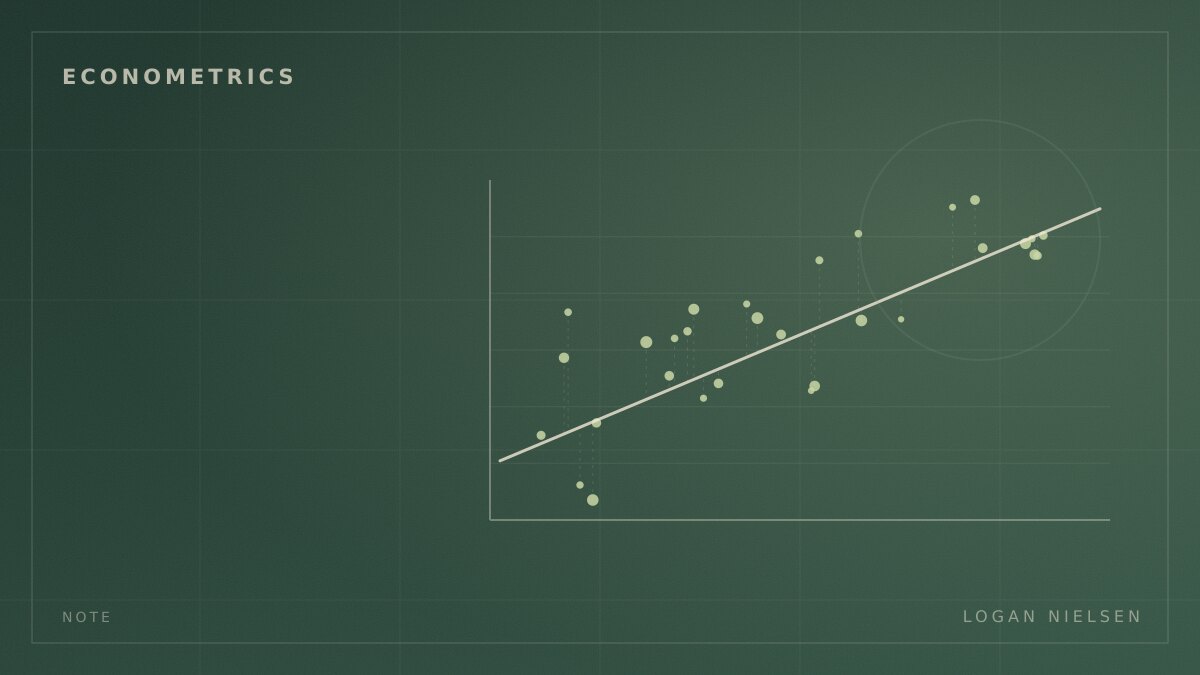
Visualizing the workhorse model for regression analysis.